Emotions

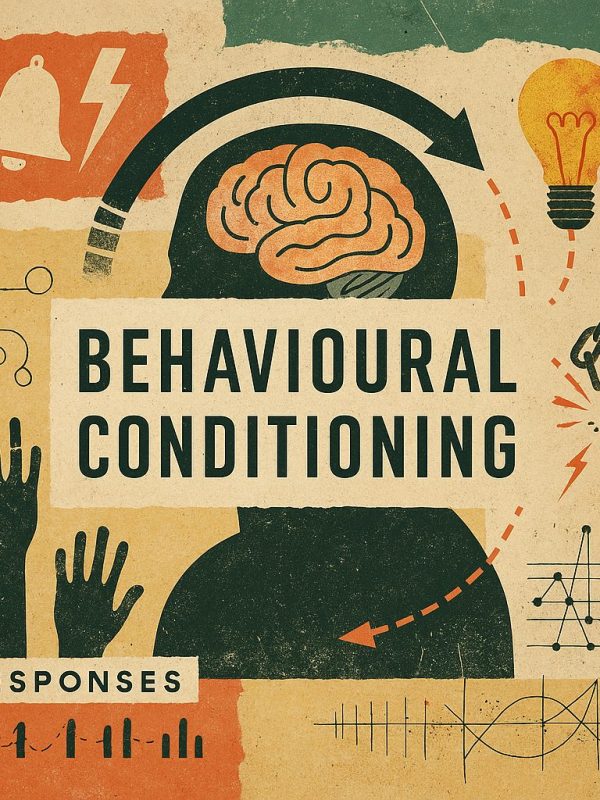
Behavioral Conditioning | CBT | Envision your Evolution

Behavioral Conditioning in Cognitive Behavioral Therapy

Cognitive Behavioral Therapy (CBT) remains one of the most empirically supported and adaptable approaches in modern psychotherapy. Emerging from the fusion of behavioral learning theory and cognitive science, CBT provides an evidence-based framework for understanding how thoughts, emotions, and behaviors interconnect (Beck, 2011). While the “cognitive” component addresses the interpretation of experience, its behavioral foundations—rooted in classical and operant conditioning—explain how emotional responses and habits are learned, reinforced, and transformed.

This article explores how behavioural conditioning functions within CBT: how it shapes emotional learning, how therapists help clients unlearn maladaptive patterns, and how conditioning principles can be consciously re-applied to foster growth and resilience.

Behavioral Conditioning in Cognitive Behavioral Therapy Read article
Navigating Emotional Lability: Understanding a Complex Personality Trait

Emotional Lability: Understanding a Complex Personality Trait

Emotional lability, a multifaceted personality trait, significantly influences how individuals experience and express their emotions. It encompasses a broad spectrum of emotional responses, ranging from intense mood swings to heightened sensitivity. In this article, we will explore the intricate world of emotional lability, defining the trait, examining its subtypes, discussing potential causes, consequences, and strategies for managing and harnessing this trait effectively.

Emotional Lability: Understanding a Complex Personality Trait Read article

Train of Emotions | AI Artwork | Envision your Evolution

Unlocking the Unconscious: An Exploration of Jungian Dream Interpretation

Jung proposed that dreams serve as a tool for psychological integration, bringing to light aspects of the unconscious mind. He wrote, “The dream is a little hidden door in the innermost and most secret recesses of the soul” (“The Meaning of Psychology for Modern Man,” CW 10, para. 304). Rather than viewing dreams as merely disguised wish fulfillments, as Sigmund Freud did, Jung saw them as a bridge to our unconscious, echoing our deepest thoughts, desires, and fears.

Unlocking the Unconscious: An Exploration of Jungian Dream Interpretation Read article

Mania | The Love Attitudes Scale | Envision your Evolution

Mania

Mania is derived from the Ancient Greek term μανία, meaning “mental disorder”, from which the term “manic” is derived. Lee defines Manic love as flowing out of a desire to hold one’s partner in high esteem and wanting to love and be loved in this way, seeing specialness in the interaction. This type of love tends to lead a partner into a type of madness and obsessiveness. Manic lovers speak of their partners with possessives and superlatives, and they feel that they “need” their partners. Oftentimes, manic individuals are attracted to individuals who have low self-esteem and a weak self-concept. This kind of love is expressed as a means of rescue, or reinforcement of value. Manic lovers value finding a partner through chance without prior knowledge of their financial status, education, background, or personality traits. Insufficient expression of Manic love by one’s partner can cause one to perceive the partner as aloof, materialistic, and detached. In excess, mania becomes obsession or codependency, and obsessed manic lovers can thus come across as being very possessive and jealous.

Mania Read article

Pragma | The Love Attitudes Scale | Envision your Evolution

Pragma

Pragma comes from the Ancient Greek term πρᾶγμα, meaning ‘businesslike‘, from which terms like pragmatic are derived. Pragma is the most practical type of love, not necessarily derived from true romantic love. Instead, pragma is a convenient type of love. Pragmatic lovers have a notion of being of service, which they perceive to be rational and realistic. While they may be sincere about being useful themselves, it also translates to having expectations of a partner and of the relationship. They tend to select and reject partners based on what they perceive as desirable, compatible traits.

Pragmatic lovers want to find value in their partners and ultimately want to work with their partners to reach a common goal. The practicality and realism of practical love often contribute to the relationship’s longevity as long as common goals and values remain shared. The emphasis within pragmatic relationships is on earning, affordability, child care, and home service. The attitude of a pragmatic relationship can become disdainful and toxic if one partner sees the other as a burden.

Pragma Read article

Ludus | The Love Attitudes Scale | Envision your Evolution

Ludus

Ludus means “game” or “school” in Latin. The term is often used to describe those who see love as a desire to have fun, do indoor and outdoor activities, tease, indulge, and play harmless pranks on each other. The acquisition of love and attention itself may be part of the game.

Ludic lovers want to have as much fun as possible. When they are not seeking a stable relationship, they rarely or never become overly involved with one partner and often can have more than one partner at a time; in other words, a school of partners. They do not reveal their true thoughts and feelings to their partner(s).

Ludus Read article

Collage Artwork used as featured image for Robert Plutchik's Theroy of Emotions

Understanding Robert Plutchik’s Theory of Emotion: A Comprehensive Guide

Robert Plutchik proposed a psychoevolutionary classification approach for general emotional responses. He considered there to be eight primary emotions—anger, fear, sadness, disgust, surprise, anticipation, trust, and joy. Plutchik argues for the primacy of these emotions by showing each to be the trigger of behaviour with high survival value, such as the way fear inspires the fight-or-flight response.

Understanding Robert Plutchik’s Theory of Emotion: A Comprehensive Guide Read article

Hope | AI Artwork | Envision your Evolution

How Paul Ekman’s Theory of Emotion Can Help You Better Understand Others

The framework described by Paul Ekman is influenced by Charles Darwin and Silvan Solomon Tomkins, although he himself stated that he did not accept in tot what either of them said. Ekman sustained there are three meanings for the term “basic” as you can read his argumentation in the article.

Ekman considers that emotional expressions are crucial to the development and regulation of interpersonal relationships. His studies demonstrated that facial expressions play an important role in the formation of attachments and are involved in the formation, acceleration or deceleration of aggressive behaviour. 

How Paul Ekman’s Theory of Emotion Can Help You Better Understand Others Read article

The James'Lange Theory of Emotions - Featured Image

The James-Lange Theory of Emotions: How Our Body Shapes Our Feelings

William James, known as the father of American Psychology, developed along with his 19th Century fellow psychologist Carl Lange the James-Lange theory which considers that environmental events lead to the apparition of muscular and visceral responses, and that these responses eventually determine emotions. Instead of feeling an emotion and subsequent physiological (bodily) response, the theory proposes that the physiological change is primary, and emotion is after that experienced, as the brain reacts to the information received via the body’s nervous system.

The emotion follows the behaviour, and does not determine it.

The James-Lange Theory of Emotions: How Our Body Shapes Our Feelings Read article

Theories of Emotion in Psychology: Quick Guide featured image - Matt Cunningham Art

Theories of Emotion in Psychology: A Quick Guide for Beginners

Emotion represents a complex of affective states that implies conscious or unconscious experiences which lead to psychological responses that either inhibit or facilitate the motivation of behaviour.

Emotions exert an incredibly powerful force on human behavior. Strong emotions can cause you to take actions you might not normally perform or to avoid situations you enjoy. Why exactly do we have emotions? What causes us to have these feelings?

Theories of Emotion in Psychology: A Quick Guide for Beginners Read article

Envision your Evolution

Contemporary psychology

Envision your Evolution 2025 © All Rights Reserved
Scroll to Top