admin

Buddhism: The Psychology of Awakening and the Transformation of Suffering | Envision your Evolution

Buddhism: The Psychology of Awakening and the Transformation of Suffering

The Buddhist tradition offers a profound psychological framework for understanding human suffering and transformation. Rooted in the teachings of Siddhārtha Gautama, known as the Buddha (“the awakened one”), Buddhism emphasizes the mind’s central role in shaping perception and experience (Rahula, 1974). Rather than viewing suffering as an external affliction, Buddhist psychology identifies it as a product of attachment, craving, and delusion — patterns that can be observed and transformed through conscious awareness.
At the heart of Buddhism lie the Four Noble Truths and the Noble Eightfold Path, which together outline both the diagnosis and cure for human distress (Harvey, 2013). Through mindfulness, meditation, and ethical practice, Buddhism provides a path toward liberation — a process that deeply resonates with modern psychological approaches to self-awareness, emotion regulation, and cognitive restructuring (Kabat-Zinn, 1994; Wallace & Shapiro, 2006).

Buddhism: The Psychology of Awakening and the Transformation of Suffering Read article

Behavioral Conditioning | CBT | Envision your Evolution

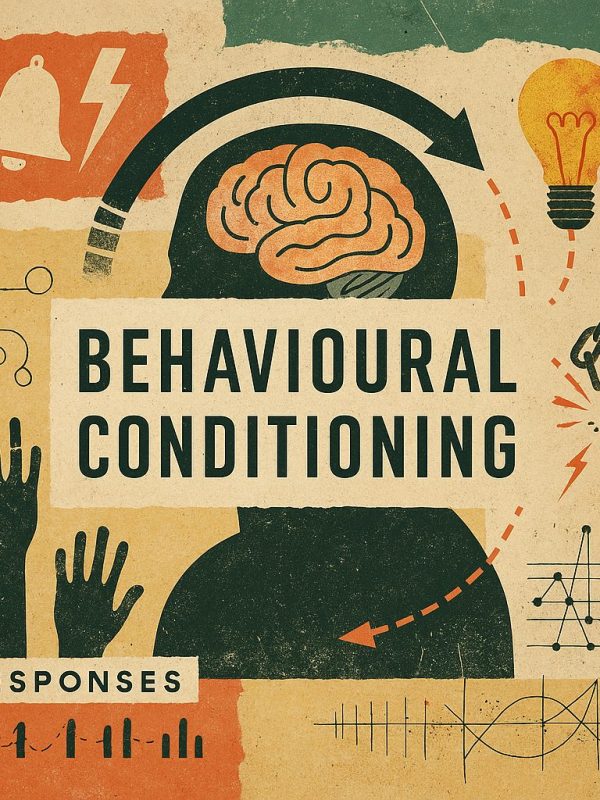
Behavioral Conditioning in Cognitive Behavioral Therapy

Cognitive Behavioral Therapy (CBT) remains one of the most empirically supported and adaptable approaches in modern psychotherapy. Emerging from the fusion of behavioral learning theory and cognitive science, CBT provides an evidence-based framework for understanding how thoughts, emotions, and behaviors interconnect (Beck, 2011). While the “cognitive” component addresses the interpretation of experience, its behavioral foundations—rooted in classical and operant conditioning—explain how emotional responses and habits are learned, reinforced, and transformed.

This article explores how behavioural conditioning functions within CBT: how it shapes emotional learning, how therapists help clients unlearn maladaptive patterns, and how conditioning principles can be consciously re-applied to foster growth and resilience.

Behavioral Conditioning in Cognitive Behavioral Therapy Read article

Individuation Phase 9 | The Archetypal Integration & Individuation Assessment | Envision your Evolution

A Symbolic Journey: How the AIIA Calculates the Individuation Phase

The Archetypal Integration & Individuation Assessment™ (AIIA) introduces a structured method to determine the participant’s current phase in the individuation process—a central concept in analytical psychology. Drawing on Jungian theory and symbolic developmental psychology, the AIIA algorithmically maps users to one of nine Individuation Phases. This mapping is based not on static typologies but on the dynamic interplay of three calculated indexes: the Archetypal Integration Index (AII), the Growth Activation Index (GAI), and the Archetypal Balance Quotient (ABQ). This article provides a grounded explanation of these indices and how they contribute to symbolic phase placement within the AIIA framework.

A Symbolic Journey: How the AIIA Calculates the Individuation Phase Read article

The Growth Edge | The Archetypal Integration & Individuation Assessment | Envision your Evolution

The Growth Edge: Transitional Readiness and the Call to Transform

Unlike the five core archetypal dimensions of the Archetypal Integration & Individuation Assessment (AIIA)—Shadow, Anima/Animus, Persona, Inner Sage, and Self—the Growth Edge is not an archetype in the Jungian sense. Instead, it functions as a transitional marker, highlighting a person’s psychological readiness for transformation. Where archetypes describe enduring psychic structures, the Growth Edge represents a liminal condition—a psycho-developmental threshold between a previously integrated identity and an emerging level of psychological complexity.

The Growth Edge: Transitional Readiness and the Call to Transform Read article

The Self Archetype | The Archetypal Integration & Individuation Assessment | Envision your Evolution

The Self Archetype: Psychological Wholeness and Individuation Compass

Among the core constructs in Jungian psychology, the Self archetype stands as the most encompassing and integrative. Unlike the ego, which mediates conscious experience, the Self represents the totality of the psyche—conscious and unconscious, personal and transpersonal. It is both origin and goal: the psychic nucleus that orchestrates development and the archetypal image of wholeness that draws the personality forward (Jung, 1959).

The Self Archetype: Psychological Wholeness and Individuation Compass Read article

The Inner Sage Archetype | The Archetypal Integration & Individuation Assessment | Envision your Evolution

The Inner Sage Archetype: Discernment, Equanimity, and Inner Witnessing

Within the symbolic system of Jungian psychology, the Inner Sage archetype signifies a deep, transpersonal center of wisdom, clarity, and discernment. Unlike more socially reactive or emotionally charged archetypes, the Sage emerges when ego-identification loosens and the Self’s observational consciousness becomes accessible. Carl Gustav Jung (1959) associated this dimension with the “mana personality”—a psychological constellation representing spiritual maturity, integration, and guidance. The Sage is less a learned role than a psychic mode of perception that sees symbolically and responds rather than reacts.

The Inner Sage Archetype: Discernment, Equanimity, and Inner Witnessing Read article

The Persona Archetype | The Archetypal Integration & Individuation Assessment | Envision your Evolution.png

The Persona Archetype: Social Identity and the Path to Authentic Expression

In analytical psychology, the persona archetype represents one of the earliest and most socially visible structures of the psyche. Coined by Carl Gustav Jung and derived from the Latin word for mask, the persona refers to the roles, behaviors, and public identities we adopt to function within society (Jung, 1953). These masks allow individuals to navigate social hierarchies, meet expectations, and participate in group life. However, the persona’s adaptive utility becomes problematic when over-identified with—masking the authentic self and stunting psychological development (Jung, 1959).

The Persona Archetype: Social Identity and the Path to Authentic Expression Read article

The Anima/Animus Archetype | The Archetypal Integration & Individuation Assessment | Envision your Evolution

The Anima and Animus: Psychological Polarity, Projection, and Inner Integration

In Jungian analytical psychology, the anima and animus are archetypes representing the inner feminine in men and the inner masculine in women. Together, they form the symbolic polarity of the psyche and serve as vital bridges between the ego and the unconscious (Jung, 1959). While these terms are often interpreted through a gendered lens, they actually reflect a broader psychological reality—the necessity of balancing opposites within the psyche. In contemporary terms, the anima/animus dimension can be understood as the inner polarity between receptivity and assertion, feeling and thinking, relatedness and autonomy (Hillman, 1985; Stein, 1998).

The Anima and Animus: Psychological Polarity, Projection, and Inner Integration Read article

The Shadow Archetype | The Archetypal Integration & Individuation Assessment | Envision your Evolution

The Shadow Archetype: Integration and Individuation in Contemporary Contexts

Among the key constructs of Analytical Psychology, the shadow archetype stands as one of the most psychologically significant and transformational. Carl Gustav Jung (1953/1969) first articulated the shadow as the unconscious complement to the conscious personality—comprising emotions, traits, instincts, and behaviors that the ego refuses to acknowledge. Often misunderstood as exclusively negative, the shadow is psychologically neutral; it houses not only disowned fears and aggression but also unexpressed creativity, sensuality, and inner power (Jacobi, 1973; Johnson, 1991).

The Shadow Archetype: Integration and Individuation in Contemporary Contexts Read article

The Big Five Personality Test

How the Big 5 Character Traits Shape Your Personality and Influence Your Future

Understanding the Big 5 Character Traits is one of the most powerful steps you can take toward realizing your full potential. These five traits—Openness, Conscientiousness, Extraversion, Agreeableness, and Neuroticism—form a well-established psychological model known for predicting personal behavior, emotional patterns, and long-term life outcomes. Extensively researched in modern psychology (John & Soto, 2021), the Big 5 Character Traits influence how you think, feel, and act across virtually every area of life, from career to relationships to health. In this guide, we explore how mastering your Big 5 personality traits can help you unlock higher performance, deeper self-awareness, and lasting success.

How the Big 5 Character Traits Shape Your Personality and Influence Your Future Read article

Envision your Evolution

Contemporary psychology

Envision your Evolution 2025 © All Rights Reserved
Scroll to Top

Envision your Evolution X Analytical Psychology

Discover the Archetypal Integration & Individuation Assessment

Understanding oneself is a fundamental human drive, yet traditional psychological assessments often fail to capture the complexity of inner experience, symbolic identity, or stages of existential and psychological maturation. Rooted in the principles of Analytical Psychology and inspired by the work of Carl Gustav Jung and Marie-Louise von Franz, the Archetypal Integration & Individuation Assessment (AIIA) offers a reflective model for exploring the internal terrain of the psyche. This model is based on archetypal constellations and one’s evolving relationship to the self, the unconscious, and others.