In this article you will read about:
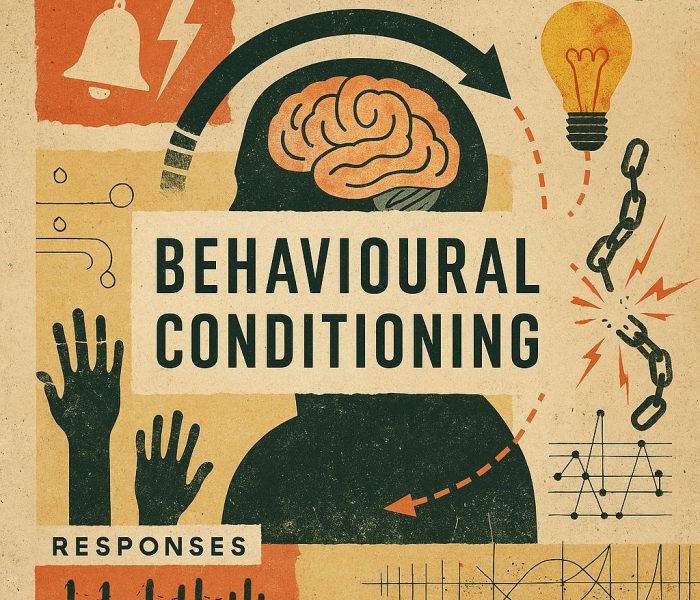
Introduction to Behavioural Conditioning
Cognitive Behavioral Therapy (CBT) remains one of the most empirically supported and adaptable approaches in modern psychotherapy. Emerging from the fusion of behavioral learning theory and cognitive science, CBT provides an evidence-based framework for understanding how thoughts, emotions, and behaviors interconnect (Beck, 2011). While the “cognitive” component addresses the interpretation of experience, its behavioral foundations—rooted in classical and operant conditioning—explain how emotional responses and habits are learned, reinforced, and transformed.
This article explores how behavioural conditioning functions within CBT: how it shapes emotional learning, how therapists help clients unlearn maladaptive patterns, and how conditioning principles can be consciously re-applied to foster growth and resilience.
1. The Behavioral Foundations of CBT
CBT originated as a reaction against purely insight-based and psychoanalytic therapies, offering a more structured, measurable, and action-oriented model. Its behavioural roots trace back to Ivan Pavlov’s (1927) experiments on classical conditioning and B.F. Skinner’s (1953) work on operant conditioning, both of which revealed that human behavior could be shaped by environmental stimuli and consequences.
In the 1960s and 1970s, Aaron T. Beck and Albert Ellis integrated these insights with cognitive theory, establishing the premise that distorted thinking interacts with learned behaviors to create cycles of psychological suffering (Beck, 2011; Ellis, 1962). Thus, CBT is not simply about “positive thinking” — it is about re-training both the mind and the environmental contingencies that sustain maladaptive habits.
2. Classical Conditioning: The Roots of Emotional Learning
Classical (or respondent) conditioning explains how automatic emotional reactions arise when neutral stimuli become paired with significant experiences.
2.1. How It Works
When an emotionally charged event (such as rejection, embarrassment, or trauma) coincides with specific cues — sounds, environments, sensations — those cues can later evoke similar emotional states (Pavlov, 1927). This associative learning explains why individuals may experience anxiety in seemingly safe situations or emotional pain triggered by a tone of voice.
2.2. Conditioning and Anxiety
In anxiety disorders, neutral cues (e.g., a crowded place) become conditioned stimuli for fear. The physiological arousal that follows reinforces avoidance, preventing extinction of the fear response (Craske et al., 2014). CBT addresses this through exposure therapy, in which clients gradually face these conditioned cues under safe conditions, weakening the learned association.
2.3. Step-by-Step: Reversing Classical Conditioning
Identify the conditioned trigger.
Recognize cues linked to automatic emotional reactions.
Trace the original association.
Clarify what event or meaning first paired the cue with distress.
Create a corrective experience.
Safely expose oneself to the cue while preventing avoidance or escape.
Repeat and reinforce.
Repetition in safe contexts builds new, adaptive associations.
Integrate awareness.
Reflect on changes in perception and emotion as the conditioned response fades.
This process—known as inhibitory learning—is not about erasing fear but about establishing new, more accurate emotional predictions (Craske et al., 2014).
archetypal integration levels & individuation phase |
"It is a frightening thought that man also has a shadow side to him. The individual seldom knows anything of this; to him, it is incredible that he should ever go beyond himself. But if it is repressed and isolated from consciousness, there emerges a raging monster. Everyone carries a shadow, and the less it is embodied in the individual’s conscious life, the blacker and denser it is. The shadow is very much part of human nature, and it is only at night, that no shadow exists."
Carl Gustav Jung Tweet
3. Operant Conditioning: The Engine of Behavioral Maintenance
Operant (instrumental) conditioning focuses on how consequences shape behavior. In CBT, this principle explains why people persist in maladaptive habits despite conscious desire for change.
3.1. How Reinforcement Works
According to Skinner (1953), behaviors followed by rewarding outcomes (positive reinforcement) or relief from distress (negative reinforcement) are likely to repeat. Conversely, behaviors followed by punishment or no consequence are less likely to recur.
For instance, avoiding a stressful meeting may bring immediate relief, reinforcing avoidance. However, this short-term reduction in discomfort strengthens the avoidance loop, increasing long-term anxiety (Hofmann et al., 2012).
3.2. Steps to Reshape Operant Conditioning
Observe consequences
Track what happens before and after each behavior.
Identify reinforcement loops.
Notice how certain actions temporarily relieve discomfort.
Introduce new behaviors.
Replace avoidance or self-defeating actions with adaptive alternatives (e.g., assertiveness, relaxation).
Reinforce adaptivity.
Reward skill use with positive feedback, self-acknowledgment, or pleasurable activity.
Minimize reinforcement of maladaptive responses.
Withdraw attention or reward from unhelpful behaviors.
Through this process, new learning replaces the old reinforcement contingencies, leading to long-term behavioral change (Kanter et al., 2008).
4. The ABC Model and Behavior Chain Analysis
The ABC model (Antecedent–Belief–Consequence) is a cornerstone of CBT that integrates conditioning with cognitive insight. It helps clients map how thoughts mediate between stimulus and response (Beck, 2011). For instance, an antecedent (criticism) triggers a belief (“I’m worthless”), which produces the consequence (withdrawal or anger).
Similarly, behaviour chain analysis — commonly used in behavioural and dialectical therapies — expands this model to examine vulnerability factors, triggers, thoughts, emotions, and reinforcements (Kanter et al., 2008). By identifying where conditioning drives behavior, clients can break automaticity and exercise conscious choice.
5. Reconditioning Through Cognitive Integration
True change in CBT involves reconditioning the mind through intentional practice. This means teaching the nervous system that new responses can yield safety and reward.
5.1. Steps in Cognitive-Behavioral Reconditioning
Awareness
Identify automatic patterns shaped by conditioning.
Cognitive restructuring
Challenge distorted beliefs maintaining the behavior.
Behavioral experimentation
Test new actions to collect disconfirming evidence.
Reinforcement of success
Notice and celebrate adaptive outcomes.
Generalization
Apply new learning across contexts to strengthen integration.

Over time, clients internalize adaptive contingencies, gaining both emotional flexibility and resilience (Hofmann et al., 2012).
6. The Role of Environment and Context
CBT also acknowledges the role of environmental conditioning — how family, social, and cultural systems reinforce particular behaviors (Dobson & Dozois, 2019). A critical part of therapy is creating environments that support new learning rather than reinforcing dysfunction. For instance, when clients receive validation and recognition for adaptive coping, their motivation for change grows.
Therapists may encourage environmental modifications—such as setting boundaries, structuring routines, or engaging in supportive communities—to sustain reconditioning beyond therapy sessions.
7. The Integration of Conditioning and Cognition
What distinguishes CBT from traditional behaviorism is its integration of learning theory with cognition. Cognitive appraisals influence how conditioning operates: beliefs shape what is perceived as reinforcing or punishing (Beck, 2011). For example, two individuals may experience the same event—public speaking—but interpret it differently based on internalized associations and beliefs.
CBT thus re-teaches both how we think and how we learn, blending reflective awareness with behavioral retraining — a synthesis that supports durable change.
Conclusion
Behavioral conditioning is not merely a historical footnote in CBT; it remains its living foundation. Understanding how classical and operant conditioning shape human experience allows both therapist and client to see emotional suffering not as moral failure but as learned adaptation. By identifying triggers, reinforcement loops, and cognitive filters, individuals can consciously re-engineer their responses, cultivating psychological flexibility, emotional stability, and deeper self-understanding.
CBT thus becomes not only a method for symptom reduction but a path for re-education — training the mind and nervous system to align with clarity, compassion, and conscious choice.
Behavioral Conditioning Book Recommendations
Here is a collection of the best books on the market related to Behavioral Conditioning:
Our commitment to you
Our team takes pride in crafting informative and well-researched articles and resources for our readers.
We believe in making academic writing accessible and engaging for everyone, which is why we take great care in curating only the most reliable and verifiable sources of knowledge. By presenting complex concepts in a simplified and concise manner, we hope to make learning an enjoyable experience that can leave a lasting impact on our readers.
Additionally, we strive to make our articles visually appealing and aesthetically pleasing, using different design elements and techniques to enhance the reader’s experience. We firmly believe that the way in which information is presented can have a significant impact on how well it is understood and retained, and we take this responsibility seriously.
Click on the icon to see all your thoughts in the Dashboard.
Your Thoughts about Behavior Conditioning
It’s highly recommended that you jot down any ideas or reflections that come to mind regarding behavioral conditioning, including related behaviours, emotions, situations, or other associations you may make. This way, you can refer back to them on your Dashboard or Reflect pop-ups, compare them with your current behaviours, and make any necessary adjustments to keep evolving. Learn more about this feature and how it can benefit you.
References
- Beck, A. T. (2011). Cognitive therapy of depression. Guilford Press.
- Craske, M. G., Treanor, M., Conway, C. C., Zbozinek, T., & Vervliet, B. (2014). Maximizing exposure therapy: An inhibitory learning approach. Behaviour Research and Therapy, 58, 10–23. https://doi.org/10.1016/j.brat.2014.04.006
- Dobson, K. S., & Dozois, D. J. A. (2019). Handbook of cognitive-behavioral therapies (4th ed.). Guilford Press.
- Ellis, A. (1962). Reason and emotion in psychotherapy.
- Lyle Stuart.
Hofmann, S. G., Asnaani, A., Vonk, I. J. J., Sawyer, A. T., & Fang, A. (2012). The efficacy of cognitive behavioral therapy: A review of meta-analyses. Cognitive Therapy and Research, 36(5), 427–440. https://doi.org/10.1007/s10608-012-9476-1 - Kanter, J. W., Busch, A. M., Weeks, C. E., & Landes, S. J. (2008). The behavioral activation for depression scale (BADS): Psychometric properties and factor structure. Journal of Psychopathology and Behavioral Assessment, 30(1), 47–58.
- Pavlov, I. P. (1927). Conditioned reflexes: An investigation of the physiological activity of the cerebral cortex. Oxford University Press.
- Skinner, B. F. (1953). Science and human behavior. Macmillan.
