Design

Design Psychology: How Layout, Color & Microcopy Steer Decisions | Marketing, Branding & Design Psychology | Envision your Evolution

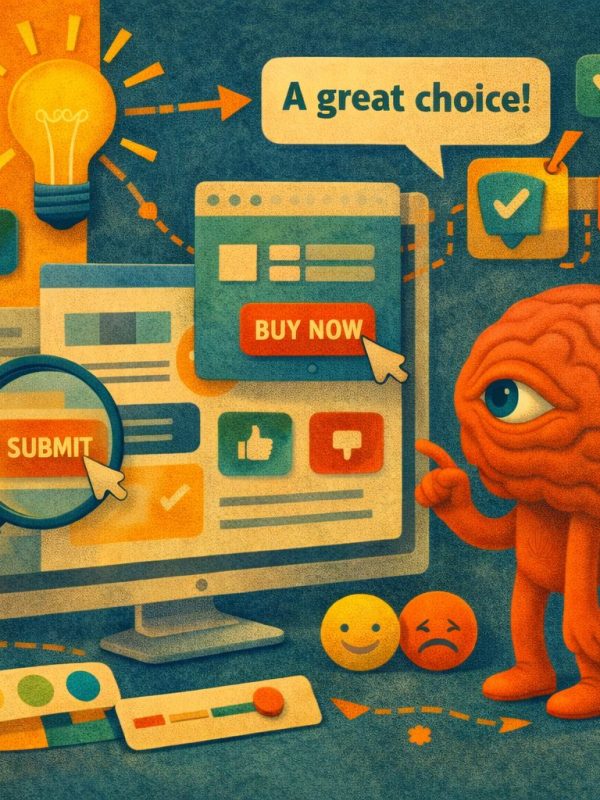
Design Psychology: How Layout, Color & Microcopy Steer Decisions

Eye-tracking research shows that people follow predictable scanning patterns on web pages, often focusing on the top and left areas first, then zig-zagging or “layer-caking” through headings and highlights (Pernice, 2019; Nielsen Norman Group, 2017; Ramotion, 2025).

At the same time, studies on color psychology indicate that up to 62–90% of first impressions about products can be driven by color alone, shaping both emotion and perceived quality (Ali et al., 2021; Arabi, 2017; Casas, 2019; Concept Studio, 2025; Insights in Marketing, 2024).

And the tiniest text on your interface—microcopy—can lower cognitive load, reduce friction, and significantly boost conversion when it clearly guides users and reflects a consistent, trustworthy voice (Dykes et al., 2025; van Veen, 2025; Slickplan, 2018; Toptal, 2023; Wanderland Agency, 2024).

This article is about those three levers:

Layout & visual hierarchy

Color & emotional signalling

Microcopy & conversational guidance

You’ll also get:

A practical 30-minute Design Psychology Review you can run on any page

A FAQ answering common design-psych questions

Design Psychology: How Layout, Color & Microcopy Steer Decisions Read article
How to Build a Brand Story That Sticks in the Brain | Marketing, Branding & Design Psychology | Envision your Evolution

How to Build a Brand Story That Sticks in the Brain

Most brand stories don’t fail because they’re “bad”—they fail because they’re built like information, not memory. People can agree with your mission, admire your offer, even feel inspired while reading your sales page—and still forget you an hour later. Why? Because the brain doesn’t store scattered facts very well. It stores organized experience: who wanted what, what got in the way, what changed, and what becomes possible next.

In this article, you’ll learn the psychology behind what makes a brand story stick: narrative transportation (immersion beats explanation), processing fluency (clarity reduces friction), self-relevance (people remember what feels personally connected), and emotion (felt meaning strengthens encoding).

How to Build a Brand Story That Sticks in the Brain Read article

Consumer Psychology 101: The Mental Shortcuts Behind Every Purchase | Marketing, Branding & Design Psychology | Envision your Evolution

Consumer Psychology 101: The Mental Shortcuts Behind Every Purchase

We like to believe we buy with logic:

“I compared the options, weighed the pros and cons, and chose the best one.”

In reality, most of the time our brain is using fast, automatic shortcuts to decide:
This feels right → click.

Those shortcuts are cognitive biases and heuristics—mental rules of thumb that usually help us make quick decisions, but also make us predictable in ways marketing can leverage (or abuse). Behavioral economists and psychologists have spent decades showing that these shortcuts explain many of our “irrational” choices in money, health, and consumption (Kahneman, 2011; da Silva, 2023).

Consumer Psychology 101: The Mental Shortcuts Behind Every Purchase Read article

Envision your Evolution

Contemporary psychology

Envision your Evolution 2025 © All Rights Reserved
Scroll to Top