Branding

Social Proof in 2025: From Testimonials to Community Screenshots | Marketing, Branding & Design Psychology | Envision your Evolution

Social Proof in 2025: From Testimonials to Community Screenshots

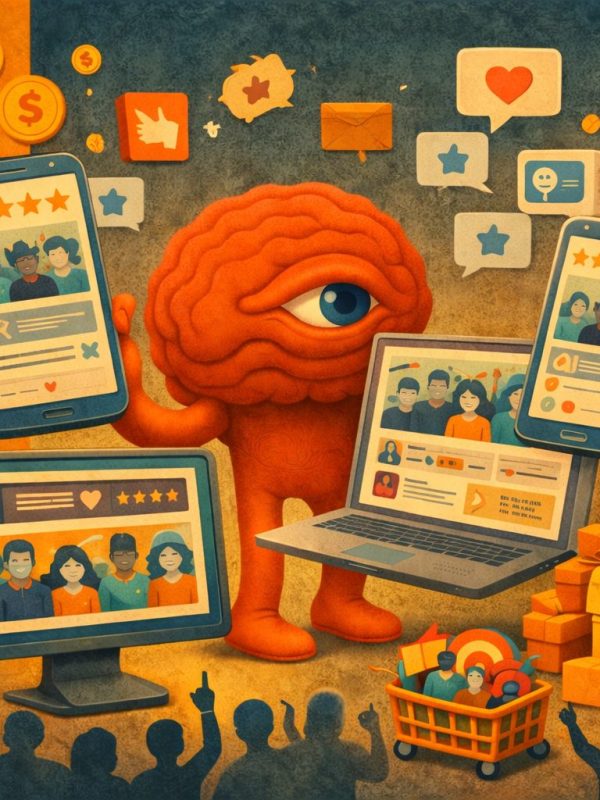
Social proof works because uncertainty is expensive. When people can’t fully verify quality in advance, they rely on social cues—what others chose, what others experienced, and who is endorsing the option—to reduce perceived risk (Cialdini, 2009). In 2025, the mechanism hasn’t changed. The marketplace conditions have.

Review ecosystems are noisier, audiences are more skeptical, and platforms + regulators are increasingly focused on deceptive review practices and artificial amplification. The FTC’s 2024 final rule banning fake reviews and testimonials (including practices enabled at scale by AI) reflects this shift toward enforcement and deterrence.
Meanwhile, consumer research suggests trust in reviews “as much as personal recommendations” has dropped sharply compared to earlier years, signaling that audiences still read reviews—but treat them more critically.

Social Proof in 2025: From Testimonials to Community Screenshots Read article

How to Build a Brand Story That Sticks in the Brain | Marketing, Branding & Design Psychology | Envision your Evolution

How to Build a Brand Story That Sticks in the Brain

Most brand stories don’t fail because they’re “bad”—they fail because they’re built like information, not memory. People can agree with your mission, admire your offer, even feel inspired while reading your sales page—and still forget you an hour later. Why? Because the brain doesn’t store scattered facts very well. It stores organized experience: who wanted what, what got in the way, what changed, and what becomes possible next.

In this article, you’ll learn the psychology behind what makes a brand story stick: narrative transportation (immersion beats explanation), processing fluency (clarity reduces friction), self-relevance (people remember what feels personally connected), and emotion (felt meaning strengthens encoding).

How to Build a Brand Story That Sticks in the Brain Read article

Envision your Evolution

Contemporary psychology

Envision your Evolution 2025 © All Rights Reserved
Scroll to Top

Find the right Psychology Testin under 60 seconds

Educational Private Trusted by 2,500+ Curious Minds

Envision your Evolution X Analytical Psychology

Discover the Archetypal Integration & Individuation Assessment

Understanding oneself is a fundamental human drive, yet traditional psychological assessments often fail to capture the complexity of inner experience, symbolic identity, or stages of existential and psychological maturation. Rooted in the principles of Analytical Psychology and inspired by the work of Carl Gustav Jung and Marie-Louise von Franz, the Archetypal Integration & Individuation Assessment (AIIA) offers a reflective model for exploring the internal terrain of the psyche. This model is based on archetypal constellations and one’s evolving relationship to the self, the unconscious, and others.