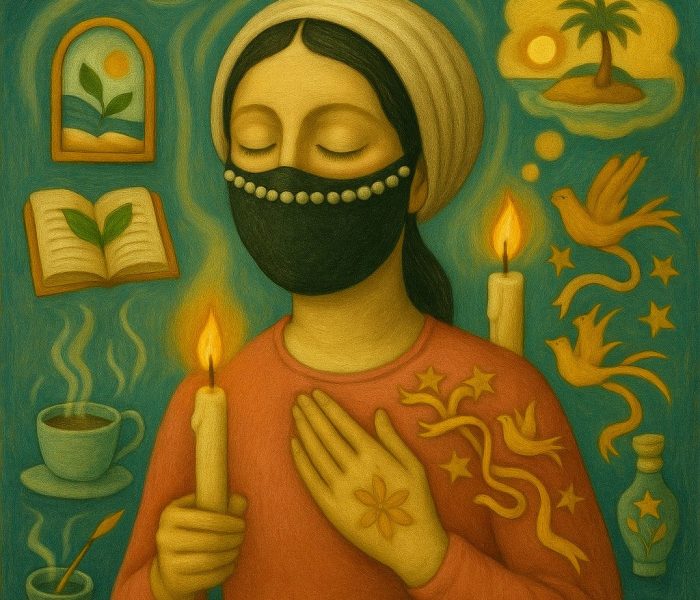

I – Imagery
Imagery uses the mind’s ability to imagine to create a brief inner refuge from distress. In DBT, clients are encouraged to:
Picture a safe place—a room, beach, forest, or spiritual space that feels secure.
Visualize getting through the crisis and later looking back with pride.
Imagine supportive figures (real, fictional, or symbolic) standing beside them.
This kind of guided imagery can reduce physiological arousal and support emotion regulation, particularly when practiced repeatedly (Linehan, 2015; Psychotherapy Academy, 2022).
M – Meaning
Meaning invites you to ask:
“Given that this pain is here, is there any meaning or purpose I can find in how I respond?”
Examples include:
Framing the moment as an opportunity to practice a new skill instead of repeating an old pattern.
Seeing suffering as part of a larger journey of growth, recovery, or spiritual development.
Remembering values (e.g., staying sober, being a caring parent, living authentically) and letting them shape your response.
Finding meaning doesn’t deny that something is unfair or painful; it simply asks, “How can I suffer less destructively?” Meaning-making has been linked with resilience and better adjustment to adversity in broader psychotherapy research (Fassbinder et al., 2016).
P – Prayer (or Spiritual Connection)
In the original DBT materials, Prayer refers to turning toward a sense of something larger than oneself—this might be God, a higher power, spiritual tradition, nature, or simply a sense of wise, transpersonal guidance (Linehan, 2015).
For spiritually oriented individuals, this could include:
Silent or spoken prayer.
Reading sacred texts or mantras.
Asking for strength, guidance, or acceptance.
For those who are not religious, this “P” can be reframed as “Practice Spirituality” or “Connect with Something Bigger”:
Feeling connected to nature, humanity, or collective struggle.
Reflecting on values or ideals that feel larger than immediate pain.
The aim is not to demand that distress disappears, but to lean into a sense of support and meaning beyond the self.
R – Relaxation
Relaxation focuses on deliberately calming the body, which in turn reduces the intensity of emotional experience. DBT suggests using:
Paced breathing (for example, longer exhales than inhales).
Progressive muscle relaxation, gently tensing and releasing muscle groups.
Warm baths, stretching, restorative yoga, or other soothing body practices.
Relaxation-based techniques have strong empirical support for reducing anxiety and physiological arousal, and are included across many evidence-based treatments (Kabat-Zinn, 2003; Positive Psychology, 2025).
O – One Thing in the Moment
“One thing in the moment” is a direct application of DBT mindfulness: one-mindfully doing just one thing, right now (Linehan, 2015).
Examples:
Focusing entirely on washing your hands—the feeling of water, temperature, movement.
Watching the flame of a candle with full attention.
Doing a simple task (folding laundry, making tea) without multitasking.
By narrowing the focus to a single, concrete action, the mind has less room to ruminate or catastrophize. This helps reduce emotional overwhelm and brings you back into the present moment.
V – Vacation
In DBT, Vacation doesn’t necessarily mean a week away—it often means a brief, intentional break from the stressor. This might involve:
Taking a few hours off from a draining task (while staying within your responsibilities).
Going to a library, park, or café for a short change of scene.
Creating a “mini-vacation” at home: a different room, a special chair, a short media break.
The key is permission: giving yourself a time-limited period where you are not actively solving the problem, but recovering enough to face it more effectively later (Rathus & Miller, 2015).
E – Encouragement (Self-Encouragement)
The final letter, Encouragement, is often described as self-cheerleading. DBT handouts include examples like:
“I can get through this.”
“This feeling will not last forever.”
“I’ve handled difficult things before.”
Self-directed, compassionate language can reduce shame and hopelessness, and is consistent with research on self-compassion as a buffer against emotional distress (Neacsiu et al., 2010; Lancastle et al., 2024).
Encouragement is not about pretending everything is fine; it’s about reminding yourself of your capacity to survive this moment without self-destruction.
Build Your Personal IMPROVE Menu
Before you’re in full crisis mode, take 10–15 minutes to create a custom list.
On a page or notes app, write IMPROVE vertically and fill in 2–4 ideas for each:
I – Imagery
Visualize a safe place (beach, forest, room).
Picture your future self looking back, proud you coped skillfully.
M – Meaning
“This is a chance to break an old pattern.”
“My suffering can fuel compassion—for myself and others.”
P – Prayer / Spiritual Connection
Short written or spoken prayer.
Reflect on something bigger than you: nature, humanity, values, purpose.
R – Relaxation
5–10 minutes of slow breathing.
Progressive muscle relaxation, gentle stretching, warm shower.
O – One Thing in the Moment
Make tea and focus fully on each step.
Fold laundry one item at a time, staying with the sensation.
V – Vacation
30–60 minutes off from problem-solving (movie, book, walk, café).
A “mental vacation”: time-limited break from thinking about the issue.
E – Encouragement
“This will pass; feelings are not forever.”
“I don’t have to like this to survive it.”
“Using skills is success, not perfection.”
Keep this list somewhere visible: journal, phone note, printed card.
A 20–30 Minute IMPROVE Routine for High Distress
Use this when your distress is around 7–10/10 and you notice strong urges to do something that would make things worse (self-harm, blow up at someone, binge, drink, etc.).
Step 1 – Name the Crisis (1 minute)
“I’m at a 9/10 and my urge is to __.”
Commit: “For the next 20–30 minutes, I will only use skills, not act on urges.”
Step 2 – Pick 3–4 Letters from IMPROVE (15–20 minutes)
Example combo: I + R + O + E
Imagery (5 minutes)
Close your eyes and walk through your safe place in detail: sights, sounds, temperature, smells.Relaxation (5–10 minutes)
Do paced breathing (inhale 4, exhale 6) or tense–release each muscle group from feet to face.One Thing in the Moment (5 minutes)
Choose a simple task—washing a dish, making a drink, brushing your hair—and do it one-mindfully, returning your attention every time it drifts.Encouragement (1–2 minutes)
Speak or write a few phrases:“I’ve survived intense feelings before.”
“Right now my job is to get through this moment safely.”
(You can swap in Meaning, Vacation, or Prayer depending on the situation and what resonates.)
Step 3 – Recheck Your Distress (2 minutes)
Re-rate your distress from 0–10.
Even a drop from 9 to 7 is real progress; it gives more room for Wise Mind choices.
Step 4 – Choose the Next Wise-Mind Step
Ask:
“What’s the most effective thing I can do now?”
Options might be: use another DBT skill, rest, reach out to someone safe, or schedule time later to problem-solve the situation.
Daily “Micro-Practice” to Make IMPROVE Automatic
The more you practice IMPROVE outside of intense crises, the easier it is to access when everything is on fire.
Try this micro-practice once a day:
Pick one letter of IMPROVE.
Use that skill for 3–5 minutes during mild stress (annoyance, worry, tension).
Briefly note: “What did I try? Did my mood shift at all?”
Over a few weeks, you’ll start to build a reflex: when distress spikes, your brain is already familiar with Imagery, Relaxation, Encouragement, etc. and they’ll feel less forced or awkward.